
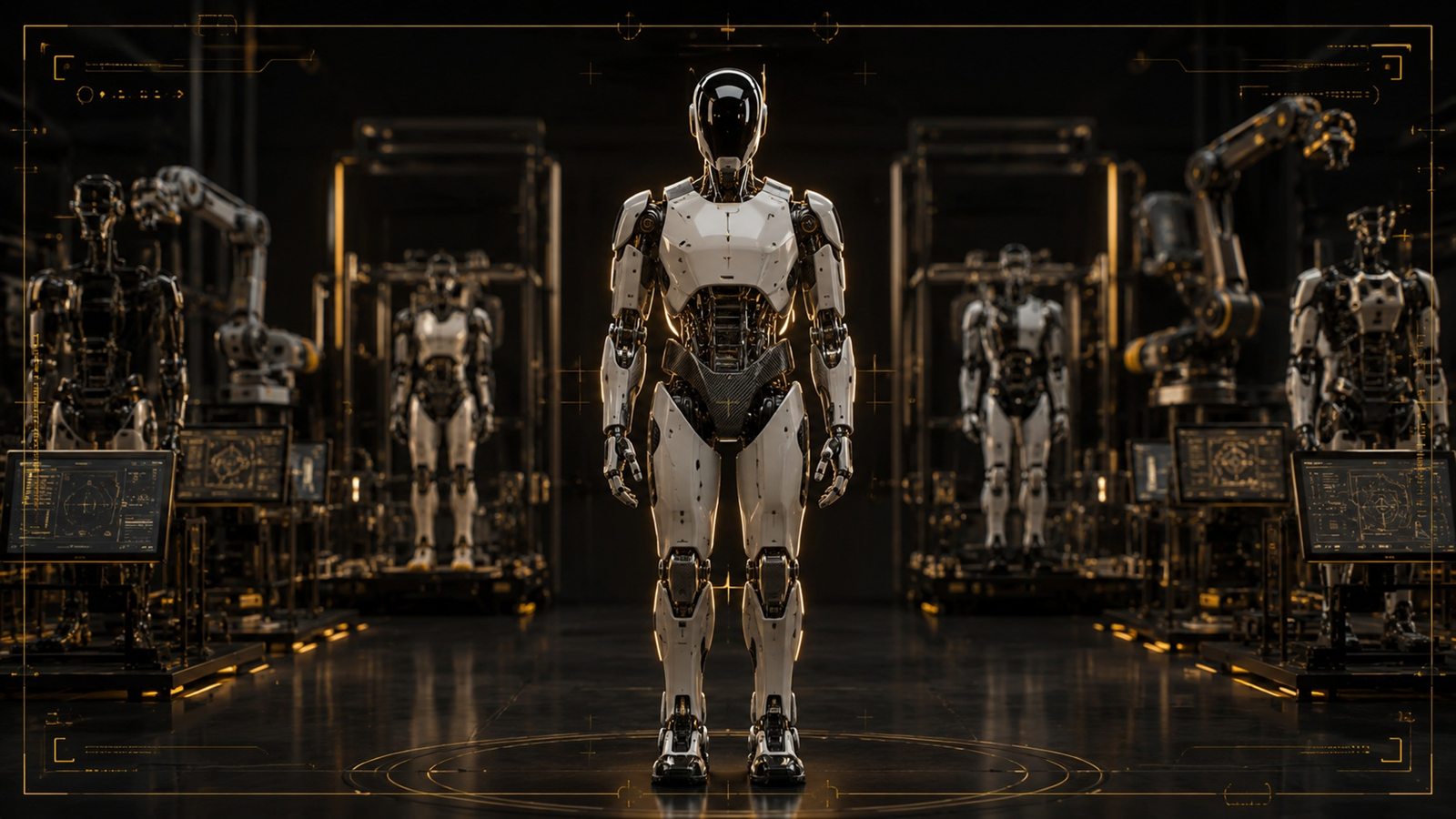
1X’s humanoid robot, NEO, has just reached a major milestone: it is no longer just a demonstrator shown in videos or a product open for pre-orders. With the opening of the NEO Factory in Hayward, California, and the agreement signed with EQT to make up to 10,000 robots available to its portfolio companies between 2026 and 2030, 1X is entering the phase that truly interests industrial operators: production, fleet management, support, and operation.
At Bybotix, this places NEO at Level 4 of maturity: Mass Production & Fleets.
It is not yet Level 5. A Level 5 robot is fully commercialized, widely available, deployed at scale with consolidated customer feedback and proven support. NEO is not quite there yet. However, it clearly surpasses the Level 3 threshold of a robot demonstrated in real-world conditions: 1X now has an announced industrial capacity, a dedicated factory, a clear volume trajectory, and a multi-site deployment framework.
Why This Shift to Level 4 Matters
Humanoid robotics has long been dominated by three formats: promotional videos, lab prototypes, and limited pilots. While useful, these formats do not prove exploitability.
A robot becomes industrial when three conditions are met:
- A repeatable production capacity
- A customer network capable of absorbing volumes
- An organized support, maintenance, training, and field data infrastructure
1X’s announcement ticks all three boxes, at least on paper. The Hayward NEO Factory covers 58,000 sq ft and already employs over 200 people. 1X states that the site is vertically integrated and aims for an initial capacity of 10,000 NEOs per year with gradual automation scaling.
This is precisely what shifts NEO from the category of 'interesting robot' to 'industrial platform to watch'.
Hayward: The Factory is More Important Than the Robot Video
In the humanoid market, public attention often focuses on walking, hands, speed, or manipulation demos. For a professional buyer, the most important information is elsewhere: how many units can be produced, repaired, updated, and replaced?
The opening of Hayward answers this question much better than any YouTube demonstration.
An integrated factory allows 1X to master more components, reduce fix times, standardize batches, and collect failure data faster. This is where economies of scale truly begin: not just on the purchase price, but on the total cost of ownership (TCO).
NEO’s target cost, around $20,000, is aggressive for a bipedal humanoid. The robot stands at 1.68m, remains relatively lightweight, and claims a lifting capacity of up to 70 kg according to public specs.
However, the catalog price is not enough. For a fleet, TCO cost lines will be the determining factors.
The EQT Deal: An Operation Accelerator Rather Than a Simple Purchase Order
The agreement with EQT is often summarized in the media as '10,000 robots sold'. We must be more precise.
The release indicates a joint intention to facilitate the deployment of up to 10,000 humanoid robots across EQT's global portfolio companies between 2026 and 2030. Each company retains the final decision to implement. This is a collaboration and learning framework, not a traditional financial commitment or a firm purchase of 10,000 units.
What 1X gains with EQT is not just a potential customer base. It is a network of about 300 companies spanning multiple sectors: manufacturing, logistics, services, healthcare, and site operations. For a humanoid manufacturer, this diversity is invaluable. It allows them to test robots in diverse environments, identify profitable use cases, and build an operational database that is impossible to replicate in a lab. The real strategic asset here is large-scale operational logistics.
Our Conclusion: A Clear Signal of Scaling
The NEO Factory gives 1X a solid manufacturing foundation. EQT provides a massive multi-sector experimental field. Together, these two elements create the conditions for accelerated industrial learning. NEO fully deserves its Level 4 Bybotix rating today.