
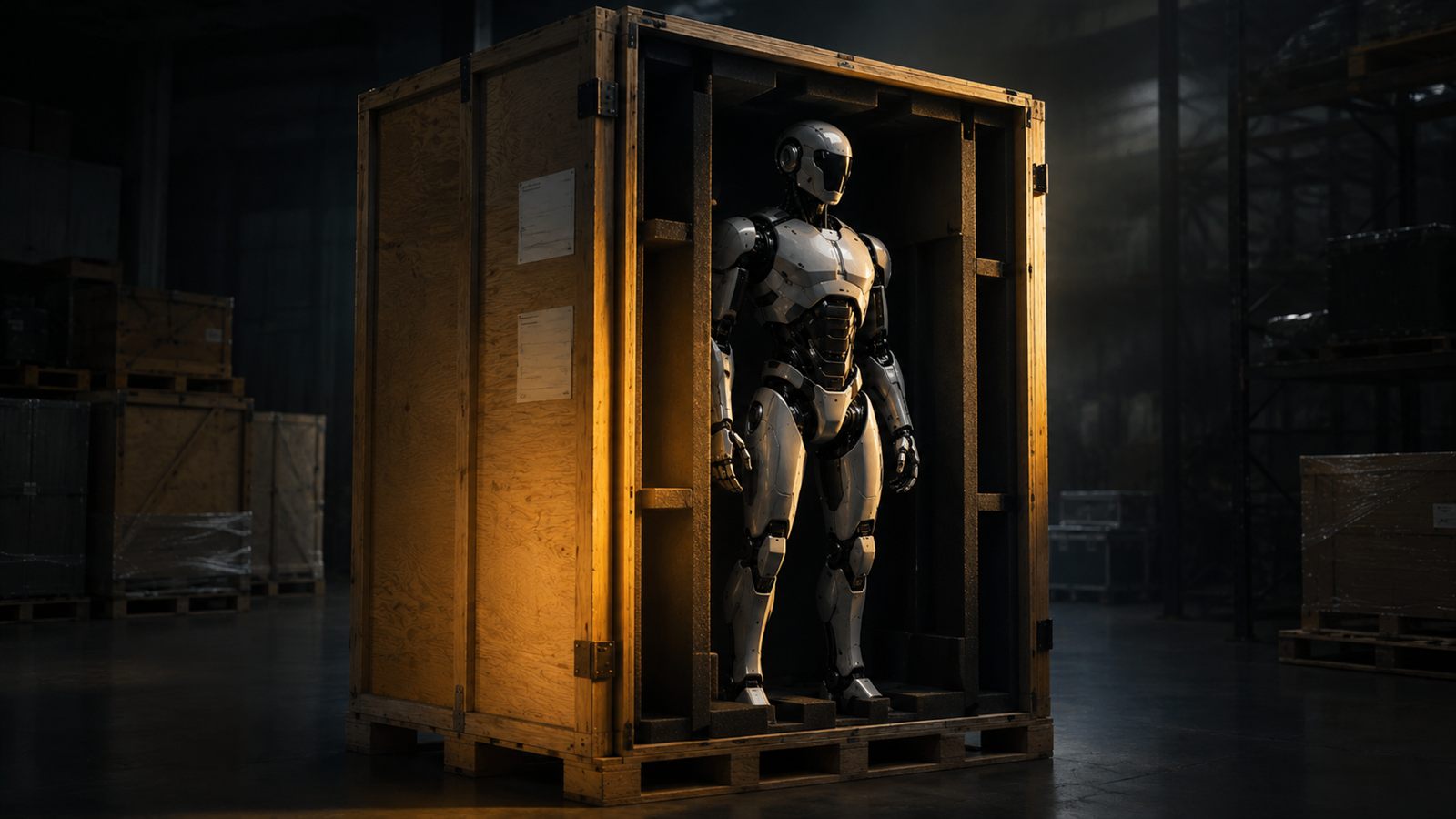
Buying an advanced robot from outside Europe looks, on paper, like a regular online order. In practice, it's importing a machine — with everything that implies for customs, conformity, safety and support. That's where many projects go wrong.
Here, without jargon, is what to clarify before you pay — whether you're an enthusiast, a school, a lab or an integrator.
A robot is not an IT accessory
A humanoid or a quadruped carries powerful motors, a large battery, radio (Wi-Fi, sometimes cellular), software, and often data collection. Each of these falls under different rules. A robot can be brilliant and, at the same time, hard to bring in and operate properly in Europe.
The real question is not « how much does it cost? », but « who is responsible for what, once the machine is at my place? ».
The 5 points to clarify before paying
- The responsible importer. Who takes responsibility for placing it on the European market? If you import directly, it's often you who becomes responsible for conformity — not the manufacturer on the other side of the world.
- Documentation. Manual, safety instructions, declarations: are they supplied, in a usable language, and consistent with the product actually delivered?
- Safety, radio, battery. A mobile robot means mechanical risks, radio modules subject to authorisation, and a lithium battery whose transport is regulated. All of this is verified, not assumed.
- Warranty and parts. If it breaks down, do you ship the machine across the world? Are there spare parts, a workshop, a realistic repair time?
- Software and data. Updates, dependence on a foreign cloud, cameras and microphones: what happens to the data, and does the robot stay usable if the remote service shuts down?
The real cost is not the sticker price
On top of the robot's price come specialised shipping (a battery means regulated freight), import duties and VAT, sometimes conformity costs, and above all the time spent managing it all. A « good deal » bought directly sometimes ends up more expensive than a supported purchase — without the peace of mind.
Checklist before ordering
- Who is the responsible importer — the seller, or me?
- Which documentation and declarations come with the product?
- How are shipping, customs and VAT handled, and at what total cost?
- What warranty, what parts, what repair time, and where?
- Does the robot stay usable without a foreign cloud service, and what happens to the data?
The Bybotix takeaway
Importing directly isn't forbidden — it's just rarely as simple as advertised. Until these answers are clear, treat the project as an exploratory pilot, not a guaranteed operational purchase.
Our role is precisely to reduce that friction: clarify responsibility, conformity, support and full cost before you commit budget. If you're unsure about a model, ask us.