
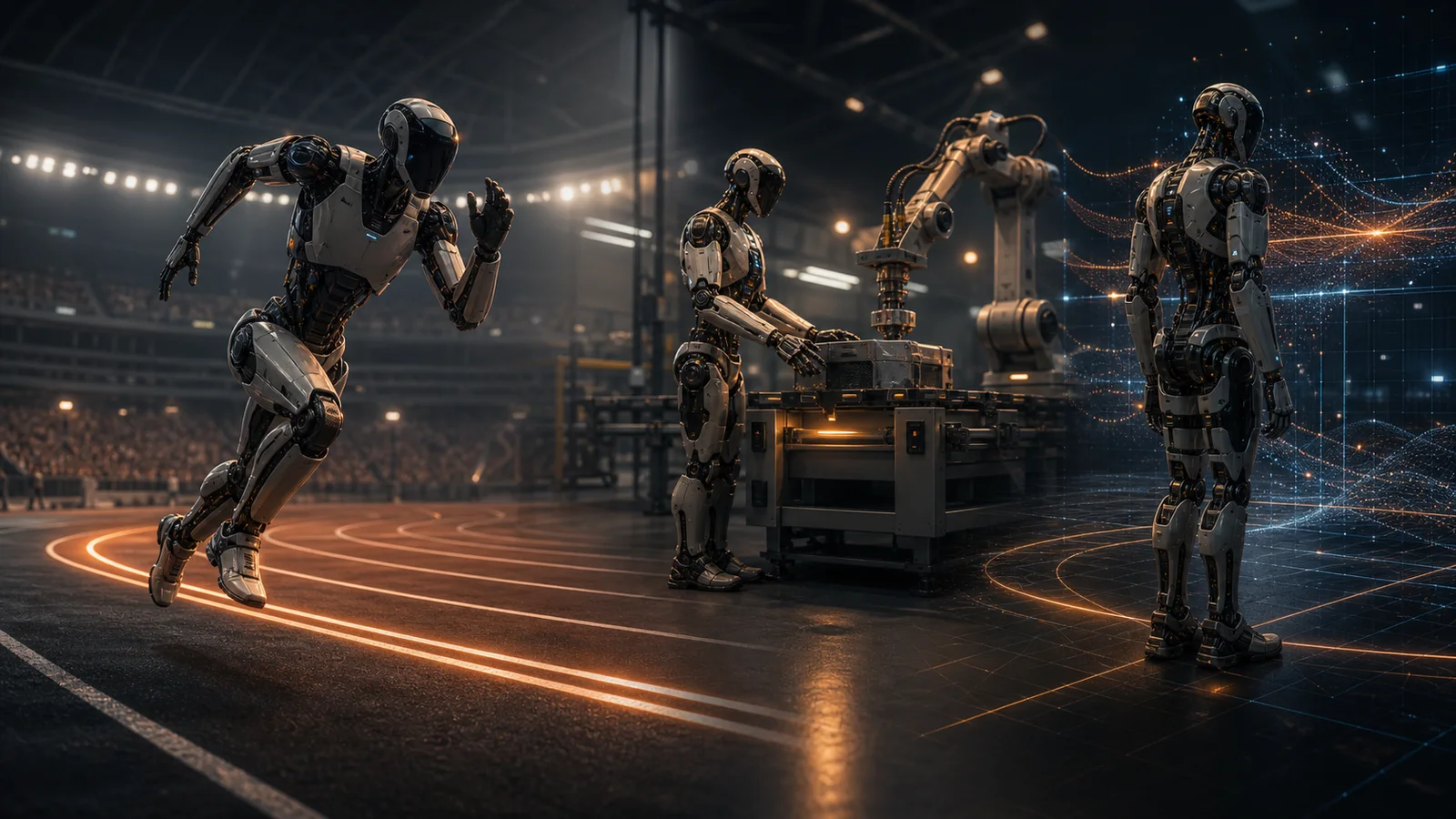
In one week, Beijing concentrated almost every narrative surrounding humanoid robots today: spectacular sports performance, industrial scale-up, stock-market enthusiasm and the promise of a “ChatGPT moment” for embodied intelligence. The images are impressive. They do not all demonstrate the same capability.
The Bybotix reading fits in one sentence: China is showing a concrete lead in whole-body control, manufacturing and data collection, but general-purpose autonomy remains the bottleneck. Running very fast, folding a garment on a trade-show stand and repeating one operation on a factory line are all genuine advances. None yet proves that a robot can independently adapt to most tasks in an unfamiliar place.
1. The Robot Games: 8.64 seconds that matter, without officially beating Usain Bolt
The second World Humanoid Robot Games ran in Beijing from 22 to 26 August 2026. Organisers reported 666 teams from 16 countries and more than 2,000 robots. The programme combined athletics, five-a-side football, manipulation, hotel work, household tasks and emergency response.
The most widely shared result came from Tiangong Ultra, developed by the Beijing Innovation Center of Humanoid Robotics: 8.64 seconds over 100 metres in the 26 August final, following 9.39 seconds at the opening and 8.86 seconds the day before. The 2026 rules upgraded the 100 metres to a fully autonomous event. The reported best time in the 2025 edition had been 21.5 seconds.
This is a remarkable whole-body control improvement: balance, stride frequency, state estimation and trajectory correction at high speed. But “beating Usain Bolt’s record” remains a media comparison. The robot competes under event-specific rules, with a different morphology, start technique and constraints; World Athletics does not recognise it as a human athletics record.
The finish exposed another part of the problem. Several robots hit the padding after the line, some producing sparks, and had to be carried away. Acceleration is one capability; decelerating, protecting the machine, detecting danger and recovering without assistance are others. For an industrial customer, those failures matter more than a demonstration time.
The same caution applies to the reported 2.8843-metre robot high jump. It is a standing robot event under its own rules, not directly equivalent to a human high jump with a run-up. The strongest comparison is year on year under comparable robot-event rules.
2. China’s lead is not based on videos alone
The week’s most important signal may be less photogenic. China is assembling a complete ecosystem: robot makers, motors and gearboxes, hands, pilot factories, data-collection centres, public procurement, capital and test sites.
A report presented at the World Robot Conference claims that more than 40,000 Chinese humanoids shipped in the first half of 2026, representing 97% of worldwide volume under its methodology. The number should remain attributed to that report: the definition of a “shipped” humanoid, the share of research platforms and possible double counting materially affect interpretation. It still shows the scale claimed by China’s ecosystem.
On 19 August, Unitree began trading on Shanghai’s STAR Market. The company raised about RMB 6.1 billion and its shares closed the first session 460.34% above the offer price. That is a powerful financing and investor-confidence signal, not proof of operational profitability for customers.
Industrial trials provide more useful evidence, although the tasks remain narrow. Robots are operating in specific loading, sorting, inspection and handling steps. Chinese sources themselves acknowledge that machines can perform individual processes well while still being unable to run an entire workflow without people.
Unitree founder Wang Xingxing was notably sober in Beijing: efficiency remains below human performance on simple assembly, each new task still requires retraining, and insufficient versatility prevents mass deployment. This is exactly the distinction Bybotix tracks between demonstrated, deployed on one task and generalisable.
3. The predicted 2027 “ChatGPT moment”: what does it actually mean?
The headline many people saw came from Wang Xiaogang, chairman of ACE Robotics and co-founder of SenseTime. In a Reuters interview on 21 August, he forecast an embodied-intelligence breakthrough by the end of 2027, driven by world models and environmental data capture.
The second half of his statement matters more than the headline: even if that technical inflection arrives in late 2027, ACE expects another four to five years before broad commercial deployment across sectors. He is not promising general-purpose household robots next year.
Unitree offers a more testable definition. The “ChatGPT moment” would arrive when a robot placed in an unfamiliar environment could complete roughly 80% of requested tasks from simple voice or text instructions. Wang Xingxing estimates two to three years in a fast scenario and five to ten in a slower one.
These forecasts are neither product schedules nor scientific consensus. They are useful because they move the discussion from spectacle to four measurable questions:
- generalisation: does the skill survive a different object, light level or room?
- autonomy: how many actions need an operator, recovery or teleoperation?
- reliability: what success rate remains over hundreds of hours rather than one video?
- economics: does cost per task, including interventions, beat the alternatives?
4. What this changes for a European project
The Beijing week justifies faster monitoring and carefully designed pilots, not skipping qualification. A European company, school or integrator should now require:
- the precise autonomy level of every demonstration and any teleoperation involved;
- success rates on unseen variants, human interventions per hour and recovery time after errors;
- safety and stopping behaviour, cybersecurity, image processing and European compliance;
- actual access to parts, diagnostics, training and warranty;
- a total cost of ownership calculated around a work scenario, not the robot’s base price.
Bybotix conclusion: the 2026 Games prove a spectacular acceleration in humanoid control. China’s industrialisation is already tangible. The “ChatGPT moment” remains a credible but unproven hypothesis — and even its advocates clearly separate a software breakthrough from broad commercial adoption.