
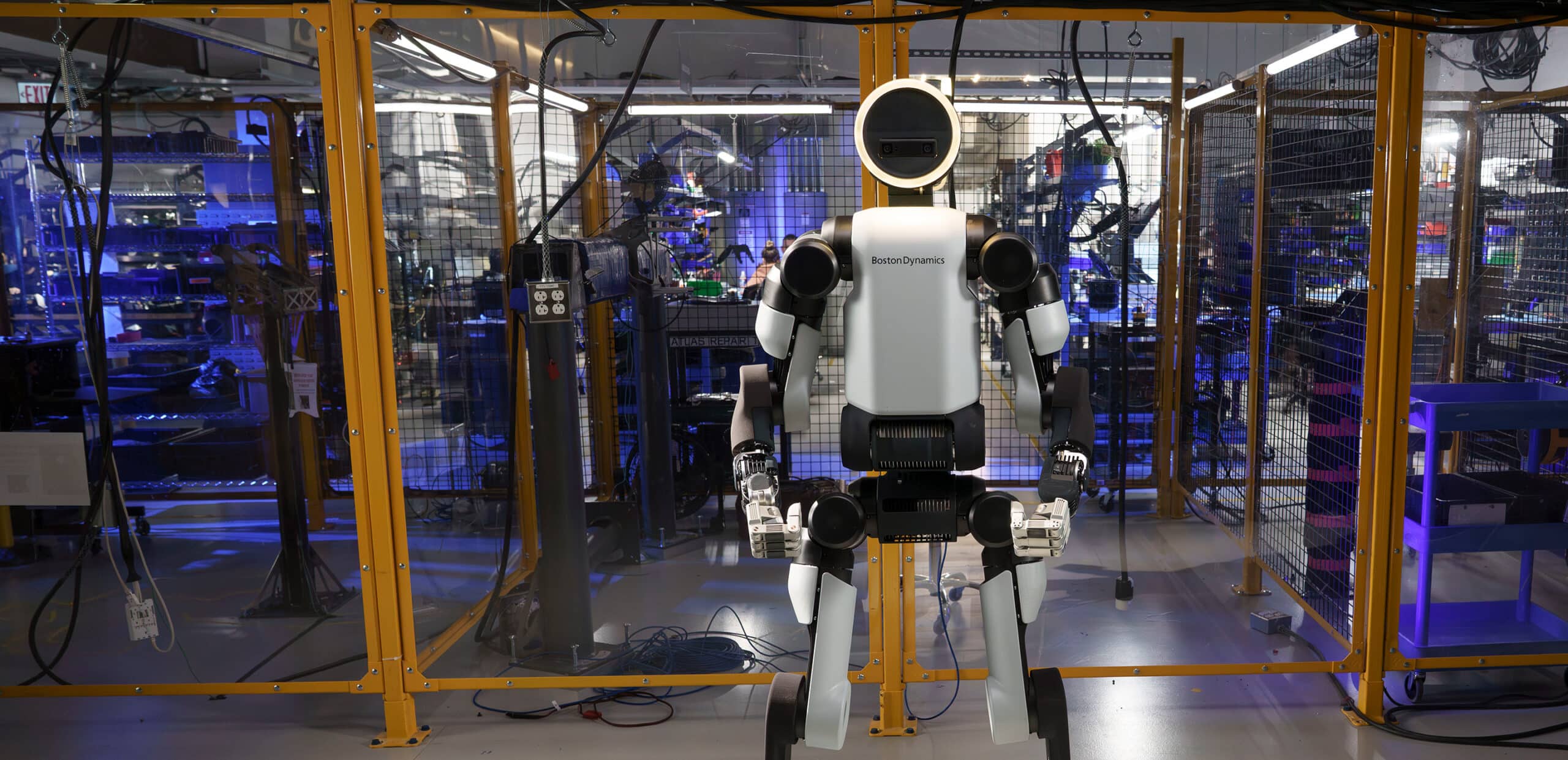
In early October 2026, Boston Dynamics made two related announcements. On the technical side, Atlas is getting a new four-finger hand with 13 degrees of freedom. At the top, Rohit Prasad became CEO on 7 October. He previously led AI for Alexa and the Amazon Nova models.
A more mobile hand, without a little finger
The previous hand had 7 degrees of freedom. The new one has 13: four in the thumb and three in each of the other three fingers. Each joint is driven directly by an enclosed actuator, with no cables crossing the joints. Pressure sensors cover the fingertips and the palm.
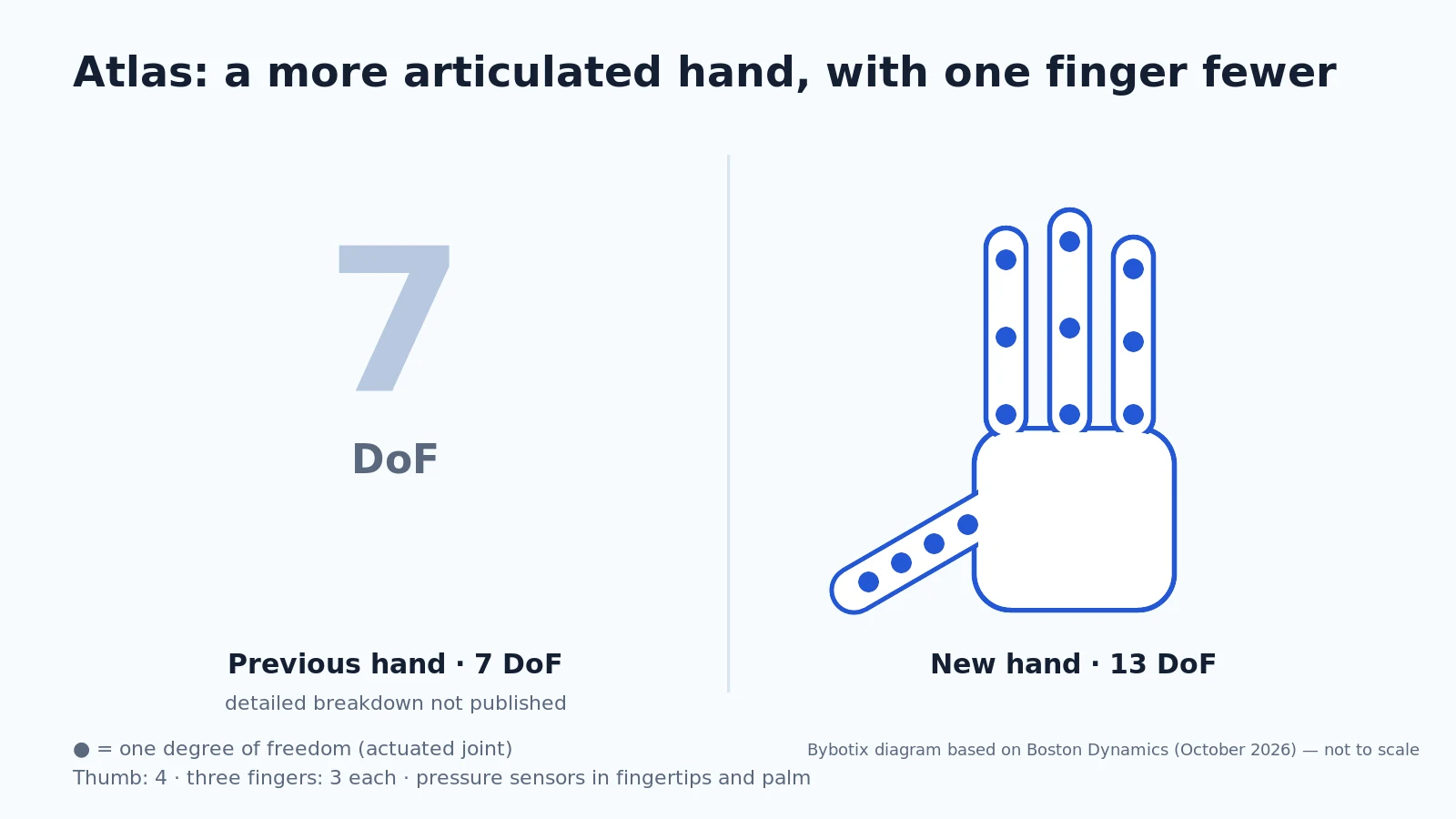
Why four fingers? According to the team, a little finger would have added three degrees of freedom, size and power draw for a limited gain. The engineers even spent a day with their ring and little fingers taped together before deciding. The hand needs to grasp varied objects and reach into tight spaces.
Designed for simulation and for the factory
Boston Dynamics says the hand was designed to be simulated accurately, so that behaviours can be trained in simulation and then transferred to the real robot. It is also intended for series production. The stated actions: pinching between the thumb and any finger, three-finger grasps, trigger tools such as a drill or a driver, reorienting an object in the hand and recovering a slipping grasp.
These capabilities are manufacturer claims. No force, payload or success-rate figures have been published, and Boston Dynamics describes its sim-to-real transfer as showing “promising initial results”.
A leader from AI, not mechanics
Rohit Prasad succeeds Robert Playter, who stepped down in late February 2026, after an interim period led by Amanda McMaster. Choosing an AI and foundation-model specialist for a Hyundai subsidiary known for its mechanics shows where the challenge now lies: teaching useful tasks to a body that is already very capable. No Atlas commercial timeline came with the appointment.
Our view: Atlas remains an industrial robot, intended primarily for Hyundai Motor Group plants, and it is not available to buy. These announcements are mainly a signal for the sector: the hand is becoming a component designed for learning, and the race depends as much on data as on hardware.
Explore the Boston Dynamics Atlas profile and humanoid shipments in the first half of 2026.
Cover image: Boston Dynamics, used to identify the platform; it shows Atlas with its previous hand. Diagram: Bybotix, based on information published by Boston Dynamics. Bybotix has not tested this hand.