
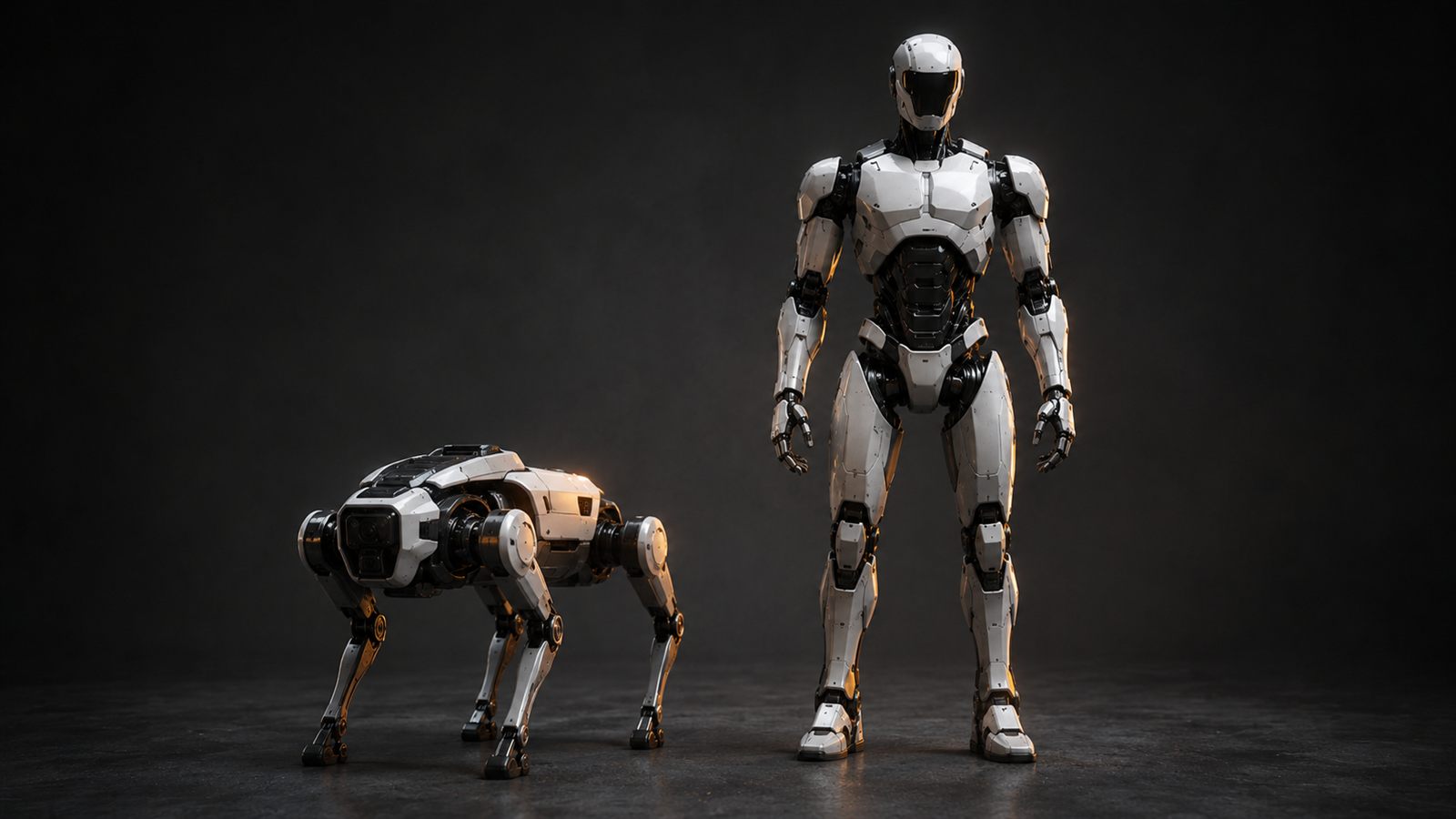
Humanoids fascinate — they make the headlines. But for a first project, they're not always the right machine. A mature quadruped often delivers a clearer result, faster, and for less.
The right reflex: start from the task, not the silhouette.
The « wow » effect is not a spec sheet
A human-shaped robot impresses, and that's fair. But the human form only matters if it genuinely simplifies the task, the interaction or the environment. Otherwise it's extra complexity — and cost — for no benefit.
When the quadruped wins
Four-legged robots are today more mature and simpler to operate for many uses:
- Inspection of industrial sites, construction, basements, hazardous areas.
- All-terrain mobility: stairs, rubble, uneven ground.
- Data collection: cameras, thermography, onboard sensors on patrol.
- Light payloads carried repeatably.
For these missions, the quadruped is often available, documented and more affordable.
When a humanoid is justified
The human form makes full sense when the environment is built for humans and you don't want to change it:
- Manipulation of objects and tools designed for human hands.
- Human spaces: handles, stairs, worktops at human height.
- Interaction and demonstration, where the human form eases acceptance.
But it's also the least mature family: fine manipulation remains the sector's great challenge, as shown by the complexity of robot hands. Many humanoids are still « demonstrated » more than « commercialized ».
Start from the task, in 4 questions
- What precise task must I accomplish, and in what environment?
- Does this task really require hands and a human form?
- Is the ground built for humans, or rough / industrial?
- What maturity level and support for the machine you have in mind?
The Bybotix takeaway
A robot that walks like a human is only useful if the human form truly serves the use. For many first projects, a well-chosen quadruped delivers a concrete result faster — and paves the way for the humanoid when it's ready for your need.
Tell us your task: we'll help you choose the family — and the model — that genuinely answers it.