
In early November 2026, StarBot Robotics, a company based in Santa Barbara, California, announced Spark, a small humanoid presented as an open development platform and built in the US. It is listed from USD 7,999, and USD 5,999 for the first 100 confirmed orders. A USD 200 deposit reserves one.
What StarBot publishes
- About 91 cm (3 feet) and 16 kg (35 pounds).
- 22 degrees of freedom across the whole body.
- 24 V battery: up to 3 h of runtime, about 40 minutes to recharge.
- Over-the-air software updates.
StarBot also offers Astra, a 1.50 m, 34 kg model (23 degrees of freedom, 48 V battery, 2 to 5 h of claimed runtime), from USD 9,999, aimed at universities and R&D teams.
What is missing for a developer platform
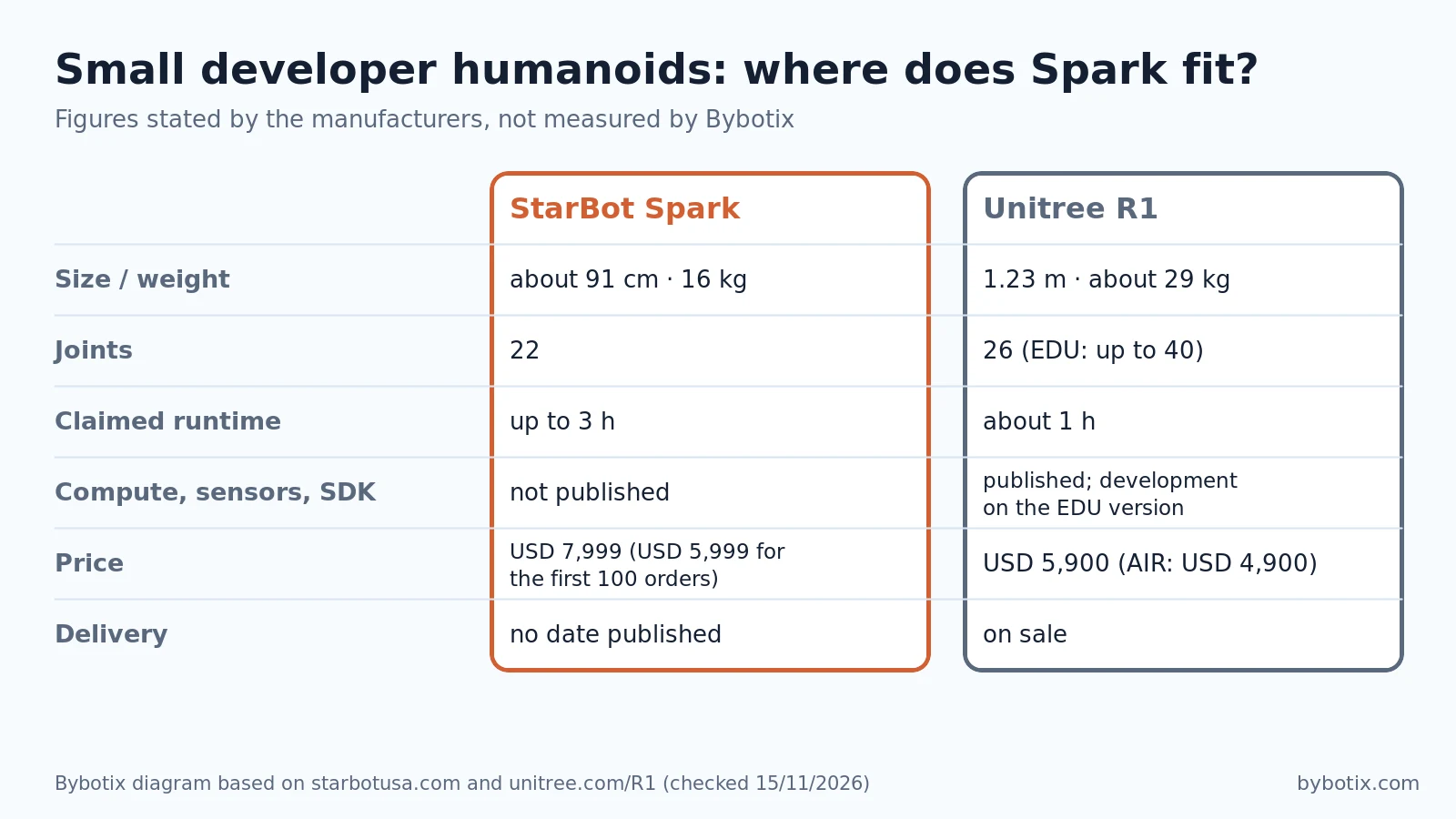
For a robot sold to developers, the most useful information is not yet online: no onboard processor, no sensors and no SDK are described for Spark. There is no delivery date or list of countries either. StarBot’s terms state that configuration, included features, taxes, shipping, lead time and support will be confirmed before the final order. The site itself is inconsistent about timing, between a September release and an 18 October sale date.
Against the existing offer
At this price, Spark competes with the Unitree R1 (USD 5,900, or USD 4,900 for the AIR version) and the Booster K1, of similar size (95 cm, 22 degrees of freedom, price on request). Both already publish their onboard compute and development tools, and are on sale. Spark’s distinctive argument is US manufacturing, which StarBot presents as a first in this category.
Our view: a new player at this price is good news for teaching and research. But until compute, sensors and SDK are published, Spark remains a promise. Before paying the deposit, ask for the full spec sheet, SDK access, the delivery date and whether it can ship to Europe.
Explore the Unitree R1 profile, the Booster K1 profile and the Bybotix comparison tool.
Visuals: Bybotix, based on information published by StarBot and Unitree. Bybotix has not tested this robot.