
On 9 November 2026, at the CoRL conference in Austin, NVIDIA presented a set of robot learning tools. Two are directly relevant to teams working on humanoids or arms: the GR00T 2 model and the Isaac Lab 3.0 simulation platform.
GR00T 2: a model that imagines before acting
NVIDIA describes GR00T 2 as an open “world action model” built on Cosmos. From recent images, the instruction and the robot’s state, it predicts both how the video will continue and the sequence of movements to execute. It was pre-trained on more than 400,000 hours of first-person video of people at work, over 10,000 hours of handheld gripper demonstrations and 23,500 hours of robot teleoperation, including a Unitree G1. NVIDIA is openly releasing 100,000 hours of this human video on Hugging Face.
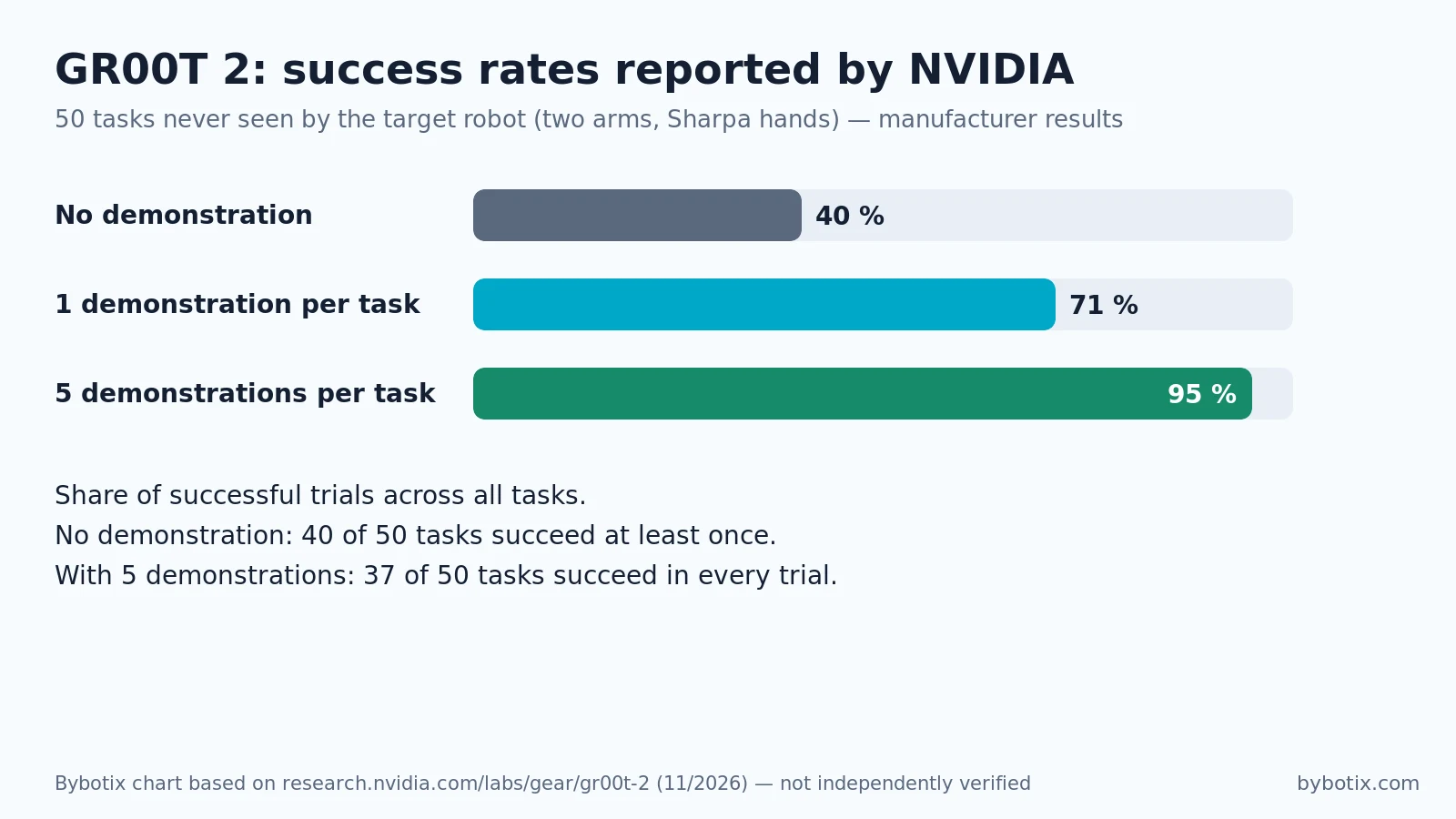
On 50 tasks never seen by the test robot, a two-armed robot fitted with Sharpa hands, NVIDIA reports 40% of trials succeeding from the instruction alone. With one demonstration per task, this rises to 71%. With five demonstrations, under three minutes of data and a half-hour fine-tune on a single RTX 5090, it reaches 95%. These tasks appeared in other robots’ data or in human video, but never in the tested robot’s own data.
Isaac Lab 3.0: already available
Isaac Lab 3.0 has been on GitHub since 20 October. It lets you choose between two physics engines, PhysX and Newton; the latter can simulate soft objects such as cables or cloth. NVIDIA reports up to 2.5 times the training throughput of version 2.3 on a vision-based dexterous manipulation benchmark. AI agents can also set up training environments. NVIDIA adds Isaac Lab-Arena 0.4, in developer preview, to evaluate policies across thousands of variations, plus two industrial benchmarks, DexBench and VABAR.
What remains to be seen
- GR00T 2 availability. The code is announced as “available in December”. The licence and model weights are not yet specified.
- Independent testing. The success rates come from NVIDIA, on a robot and a task selection defined by NVIDIA.
- Hardware requirements. One demonstration is only enough if the robot has hands, cameras and compute compatible with the model.
Our view: for a team buying a research robot, the promise is concrete: fewer demonstrations to record for each new task. Isaac Lab 3.0 can be tried now. For GR00T 2, wait for the code release and check the licence. Before buying a robot, ask whether it is already supported by NVIDIA’s tools; the Unitree G1, used in training, is one example.
Explore the Unitree G1 profile, the LeRobot SO-101 arm and GPU simulation of the SO-101 with Warp.
Visuals: Bybotix, based on information published by NVIDIA. Bybotix has not tested these tools.