
A walking humanoid, at home or at school, for the price of a small used car? Announcements are multiplying, but there is a big gap between a price listed in China, a US pre-order and a robot that can actually be delivered to Belgium or France. On 16 November 2026 we checked what can really be ordered for under about EUR 15,000.
What you can order in Europe today
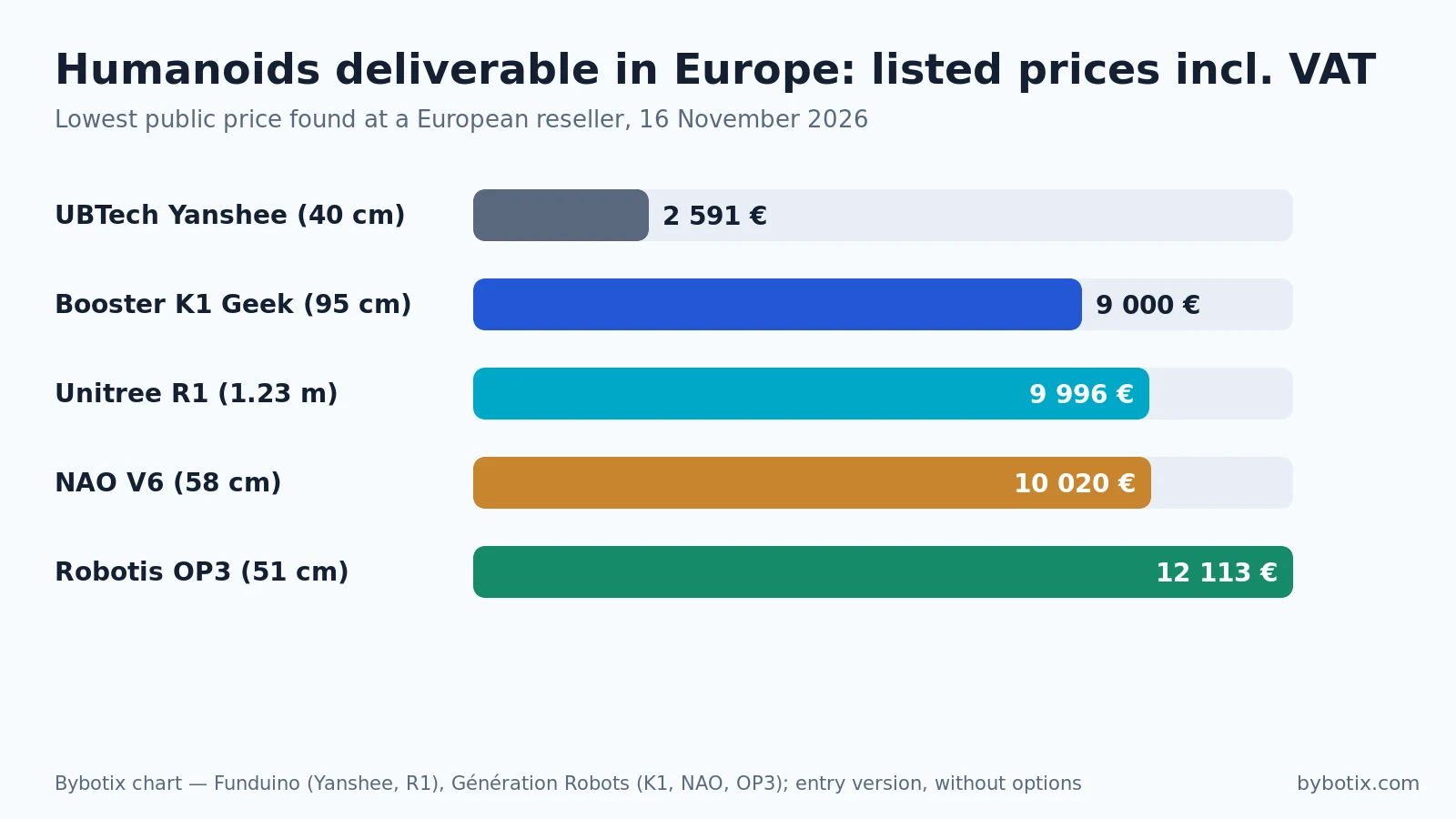
- Booster K1 (95 cm, 22 joints): Geek version from EUR 9,000 incl. VAT at Génération Robots. It is the only programmable biped around EUR 10,000 that can be delivered in Europe. Note: the Geek version has only 20 minutes of claimed runtime and a 3-month warranty; the Education version (70 minutes, 1 year) costs significantly more.
- Unitree R1 (1.23 m): USD 4,900 to 10,500 excluding tax in Unitree’s store, about EUR 10,000 incl. VAT at a German reseller. Only the EDU version is open to development: the AIR and R1 versions can be controlled but not programmed.
- NAO V6 (58 cm): EUR 10,020 incl. VAT, CE marking, two-year warranty. A safe choice for teaching, programmable in Python and with blocks, but an older design.
- Robotis OP3 (51 cm): EUR 12,113 incl. VAT, onboard Intel computer and ROS 2. Designed for research and competition.
- Small educational robots: UBTech Yanshee (40 cm) at EUR 2,591 incl. VAT, Hiwonder TonyPi Pro or AiNex (under 45 cm, Raspberry Pi) around EUR 1,000 to 1,200, often out of stock. These are servo robots for learning to program, not machines that walk around a house.
Good price, but not here yet
- Noetix Bumi (98 cm, 21 joints): sold in China since March 2026 for around CNY 9,998, about USD 1,400. It is the cheapest motorised biped. But its arms have only 4 axes and its hands are dummies. A reseller network lists it in Europe from EUR 4,672, while stating that availability is not guaranteed. Its export version, Boomy, is due to launch on Kickstarter; the campaign is not open yet and the price is unknown.
- HighTorque Mini Pi+ (68 cm): USD 6,000 to 8,000, sold out, no European reseller.
- StarBot Spark (91 cm): USD 7,999 on reservation in the US, with no delivery date or published SDK.
Above budget
The Unitree G1 costs USD 13,500 in Unitree’s store, but about EUR 20,000 and more at European resellers, and its base version cannot be programmed. The AgiBot X2 Neo (USD 25,600) and the Unitree H2-X (USD 25,400) target other budgets, as do research robots such as the Booster T2.
Why the price doubles between China and Europe
An R1 listed at USD 5,900 excluding tax by Unitree ends up around EUR 10,000 incl. VAT in Europe. The difference comes from shipping, customs duties, VAT (21% in Belgium), compliance, and the warranty and service provided locally by the reseller. Ordering directly from China costs less, but warranty and repairs are then handled remotely.
Before buying
- Controllable or programmable? At Unitree, only the EDU version opens development. For demonstrations that is fine; for a school or club it is essential.
- Real runtime: from 20 minutes to 3 hours depending on model and version.
- Warranty and repairs: who repairs it, where, and how quickly?
- Pre-orders: a deposit is not a purchase. Check the delivery date, refund terms and shipping to your country.
Our view: in Europe, the “consumer” humanoid does not really exist yet. Around EUR 10,000, the K1 and R1 are the most credible choices for anyone who wants a robot that walks; below that, they are educational robots. The next thing to watch is the arrival in Europe of small Chinese bipeds sold for around USD 1,500 in their home market.
Explore the Bybotix comparison tool and the project Advisor.
Public prices checked on 16 November 2026 on the manufacturer and reseller sites cited, without negotiation or delivery costs; they may change. Bybotix has not tested these robots.